Negative Pressure in a Home: How Airflow Can Move Contaminants Through the Built Environment
About the Micro Blog
MICRO wants to keep you up to date with information pertinent to your interests on indoor air quality and specifically what's happening in the mold industry.
When you order the CMRC course or CMI/CMRC Package you get a free e-book How to Grow Your Restoration Business by Jack Dennison.
September 11, 2026 | Posted by MICRO
When we think about indoor environmental problems, we often focus on the contaminant itself: mold, dust, bacteria, allergens, odors, VOCs, or other pollutants.
But identifying what is present is only part of the picture.
An equally important question is:
How is it moving through the building?
A contaminant hidden in a crawlspace, attic, wall cavity, basement, or garage may become more important if air movement creates a pathway that carries it into occupied areas.
One of the forces responsible for that movement is negative air pressure.
What Does Negative Pressure Mean?
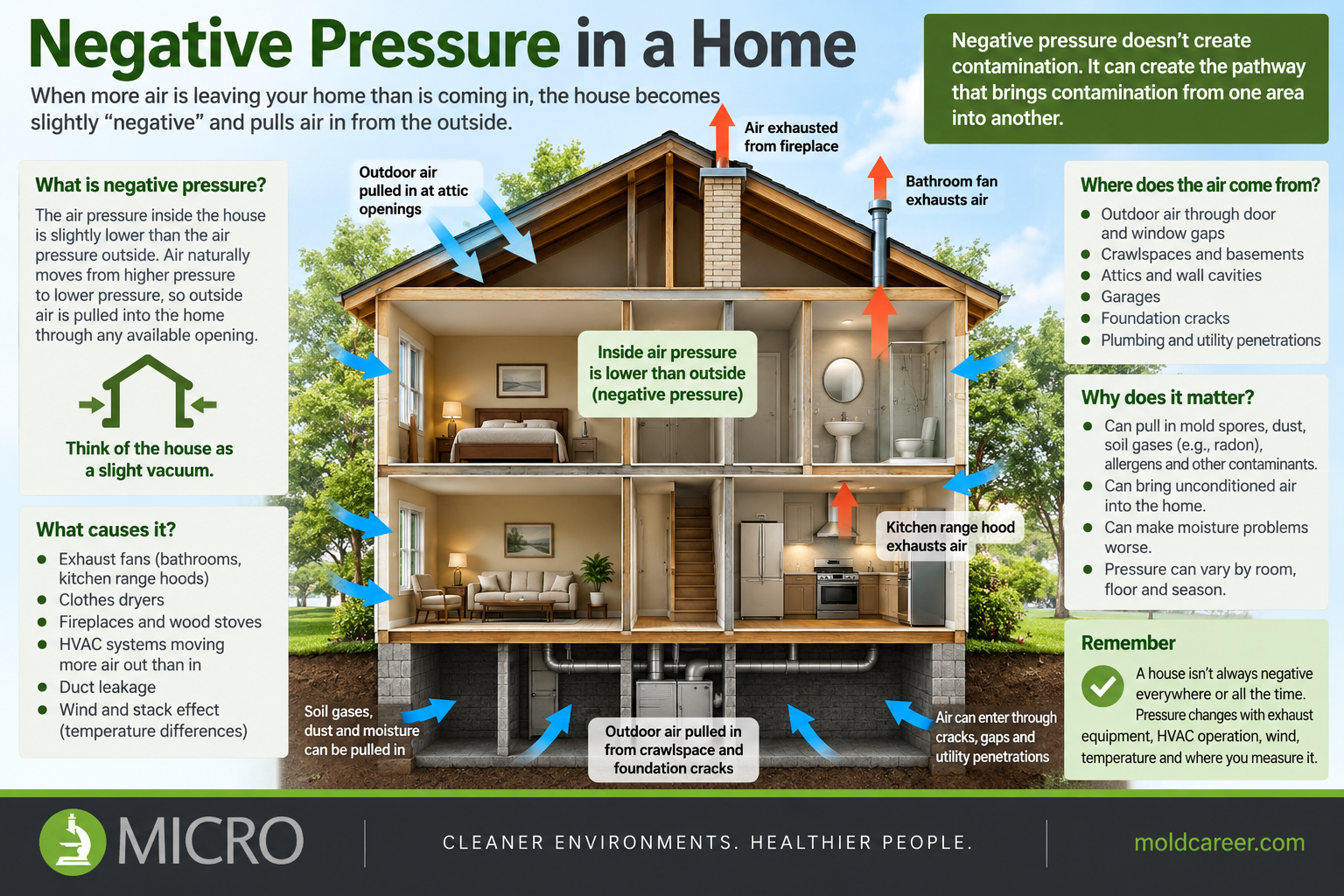
In simple terms, when a home or part of a home is negatively pressurized, it is trying to pull air in.
Air naturally moves from an area of higher pressure toward an area of lower pressure. If the pressure inside a house is lower than outdoors—or lower than an adjoining crawlspace, attic, or garage—air can be drawn toward the lower-pressure area through available openings.
Think of it as a very slight vacuum.
Those openings don’t have to be obvious. Air can move through gaps around doors and windows, plumbing and electrical penetrations, foundation cracks, wall and floor assemblies, ductwork, and other openings.
And when air moves, contaminants can move with it.
What Creates Negative Pressure?
Several forces affect pressure inside a building.
Mechanical systems are one of the most common. Bathroom exhaust fans, kitchen range hoods, clothes dryers, fireplaces, and other equipment remove air from the house. If sufficient replacement air isn’t intentionally provided, the building pulls air in from somewhere else.
HVAC systems can also create pressure differences through unbalanced airflow or duct leakage.
Wind creates pressure differences as it pushes against one side of a building and flows around the other sides.
And then there is stack effect.
Stack effect is the natural movement of air caused largely by temperature differences between indoors and outdoors. During cold weather, warm indoor air tends to rise and escape through openings near the upper portions of the building. This can create lower pressure near the bottom of the building, drawing replacement air inward.
Think of the house somewhat like a chimney:
Cooler air enters low → air warms and rises → air exits high
This becomes particularly important if that replacement air is coming through a damp crawlspace, basement, or other contaminated area.
Why Does This Matter for Indoor Environmental Quality?
Imagine mold and contaminated dust in a crawlspace.
The contamination itself is obviously important. But now suppose the living area is negatively pressurized relative to that crawlspace.
Air may be drawn through gaps around pipes, wiring, ductwork, and floor penetrations and into the occupied portion of the house.
The negative pressure didn’t create the mold.
It created a driving force capable of moving air from the contaminated area toward the occupants.
The same principle can apply to an attic containing contaminated dust, an attached garage containing vehicle exhaust or chemicals, or a wall cavity containing microbial growth.
A potential pathway might look like this:
SOURCE → RESERVOIR → PRESSURE DIFFERENCE → AIR MOVEMENT → CONTAMINANT TRANSPORT → OCCUPIED SPACE
This is why an environmental investigation shouldn’t focus solely on what is present. It should also consider how it could move.
What Can Moving Air Carry?
Depending upon the conditions, moving air can transport fungal spores and fragments, bacteria and bacterial fragments, allergens, particulate matter, resuspended dust, combustion particles, odors, certain VOCs, and soil gases such as radon.
Not every contaminant behaves the same way, and finding a pressure difference does not prove that a particular contaminant is being transported.
Instead, pressure helps us understand whether there is a potential mechanism for movement.
How Do You Know if Negative Pressure Exists?
Negative pressure can be measured with a digital differential pressure manometer.
The instrument compares pressure between two locations—for example, the living space and outdoors, or the living space and crawlspace.
Pressure differences are commonly expressed in Pascals (Pa).
For example:
–4 Pa relative to outdoors
means the indoor pressure is 4 Pascals lower than the outdoor pressure. This creates a driving force for outside air to move inward through available openings.
But there isn’t one number at which a building suddenly becomes unsafe.
The more important questions are:
Where does the pressure difference exist? Where is the replacement air coming from? Is there a contaminant source along that pathway? And where is that air ultimately going?
Measurements can also be repeated while the HVAC system, clothes dryer, bathroom fans, or kitchen exhaust are operating to determine whether those systems change the building’s pressure relationships.
More detailed investigations may use smoke or fog testing, airflow measurements, duct testing, or blower-door testing to help locate air-leakage pathways.
Negative Relative to What?
This is an important point.
A house isn’t necessarily positive or negative everywhere at the same time.
A bedroom might be negative relative to the hallway. The living space could be negative relative to the crawlspace but positive relative to the garage. Wind, temperature, HVAC operation, and exhaust equipment can change these relationships throughout the day.
So instead of simply asking:
“Is this house under negative pressure?”
a better question is:
“Which area is negative, relative to what other area, and where is that pressure difference causing air to move?”
Control the Source Before Diluting the Air
Ventilation and filtration can be valuable tools for improving indoor air quality, but they should not replace source correction.
If a wall remains wet and supports microbial growth, increasing ventilation doesn’t repair the leak.
If contaminated dust remains in a crawlspace, simply bringing more outdoor air into the house doesn’t remove that reservoir.
It is to better control where the air comes from, what it encounters, and where it goes.
A Building Is an Airflow System
Buildings are not static boxes.
Air enters, leaves, rises, falls, circulates through mechanical systems, and moves through openings and building cavities. Wind, temperature, exhaust equipment, HVAC systems, and pressure differences continually influence that movement.
Contaminants can participate in it.
That’s why a comprehensive indoor environmental investigation should go beyond asking:
“Where is the mold?”
It should also ask:
Where is the source? Where is the reservoir? What is moving the air? Where is that air going? And is there a credible pathway connecting the contaminant to the occupied environment?
Understanding those relationships can provide a much clearer picture of what is actually happening inside a building.